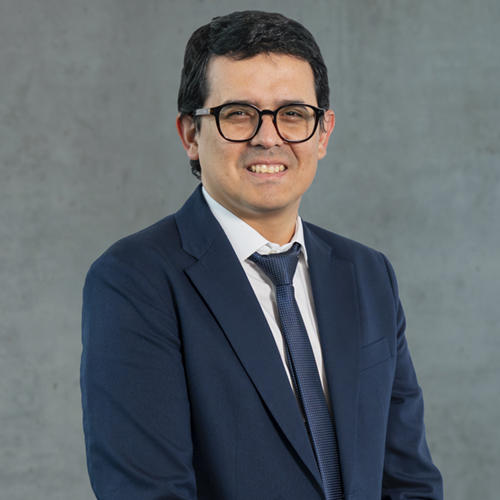
Pablo Salgado Mendoza
Jefe de Programa de Doctorado en Ingeniería
Contacto

psalgado@ucsc.cl
Pablo Salgado Mendoza
Jefe de Programa de Doctorado en Ingeniería
Título Académico:
Licenciado en Química, Universidad de Concepción
Grado Académico:
Doctor en Ciencias mención Química
Curso que dicta
Pregrado
- Introducción a la química de materiales y nanomateriales
- Química
- Ciencias y tecnologías de los materiales
Postgrado
- Biorrecursos y nanomateriales para la remediación de recursos hídricos
- Fundamentos químicos de los materiales sólidos
Líneas de investigación

Síntesis verde de nanopartículas
Procesos de oxidación avanzada
Síntesis verde de nanopartículas
Procesos de oxidación avanzada
Proyectos
2025. “Desarrollo de tecnologías basadas en nanomateriales que permitan el uso de agua para regadío|”. Proyecto interno Ingeniería 2030 UCSC. Investigador Responsable.
2023-2026. “Exploring the biosynthesis of a silver silicate-based nanomaterial using waste materials and seawater for the efficient removal of contaminants in water”. ANID FONDECYT de Iniciación N°11230671. Investigador responsable.
2023-2024. “Generación de biofiltro a base de sarmiento para tratamiento de aguas residuales como una medida de valorización de biomasa agrícola”. Proyecto interno Fondo de Innovación abierta con socios estratégicos UCSC. Coinvestigador.
2022-2023. “Desarrollo de filtro a escala industrial basado en nanotubos de nanopartículas de carbono que permita reutilizar aguas residuales de la industria acuícola”. Proyecto interno Fondo de Innovación abierta con socios estratégicos UCSC. Investigador responsable.
2022-2023. “Producción de ladrillos de mayor densidad a partir de coproductos siderúrgicos”. Contrato tecnológico UCSC-CAP. Coinvestigador.
2021. “Consorcio Tecnológico Minero de Economía Circular COTMEC”. Contrato Tecnológico BHP-UCSC. Coinvestigador.
2020-2022. “Fortalecimiento de la investigación y docencia del Doctorado en Ingeniería Civil de la Facultad de Ingeniería de la UCSC en el área de Hidráulica y Medio Ambiente con énfasis en el uso de nanomateriales para la remediación de aguas contaminadas”. ANID Subvención a la Instalación en la Academia N° PAI77190082. Investigador Principal.
2018-2020. “Desinfección de aguas servidas provenientes de un humedal de flujo subsuperficial por nanopartículas de cobre y hierro en presencia de radiación solar y H2O2”. ANID FONDECYT de Postdoctorado N°3180566. Investigador Responsable
2017-2018. “Desinfección de aguas residuales tratadas para su reúso en la agricultura vía radiación solar y nanopartículas obtenidas a partir de residuos vegetales”. FONDAP CRHIAM. Investigador postdoctoral.
Publicaciones
C. Balboa, D.V. Morales, P. Salgado (2025) Deterioration of Water Quality Between 2017 and 2021 in the Coronel Aquifer, Chile. Water, Air, & Soil Pollution, DOI: 10.1007/s11270-025-07986-0.
N. N. Figueroa, A. Brante, J.-C. Leclerc, P. Salgado & C. Oyarzo-Vera (2024) The physical and mechanical consequences of incorporating industrial residues into mortar and concrete mixtures for eco-friendly marine constructions. Innovative Infrastructure Solutions, DOI: 10.1007/s41062-024-01774-1.
P. Salgado, E. Aedo and G. Vidal (2024) Green Synthesis of Fe2O3 Nanoparticles Using Eucalyptus globulus Leaf Extract on Pinus radiata Sawdust for Cationic Dye Adsorption. Nanomaterials. DOI: 10.3390/nano14221832.
P. Salgado, K. Márquez, and G. Vidal (2024) Biogenic Synthesis Based on Cuprous Oxide Nanoparticles Using Eucalyptus globulus Extracts and Its Effectiveness for Removal of Recalcitrant Compounds. Catalysts. DOI: 10.3390/catal14080525.
P. Salgado, O. Rubilar, C. Salazar, K. Márquez, G. Vidal (2024) In Situ Synthesis of Cu2O Nanoparticles Using Eucalyptus globulus Extract to Remove a Dye via Advanced Oxidation. Nanomaterials. DOI: 10.3390/nano14131087.
P. Salgado, L. Bustamante, D. J. Carmona, M. F. Meléndrez, O. Rubilar, C. Salazar, A. J. Pérez, G. Vidal (2023) Green synthesis of Ag/Ag2O nanoparticles on cellulose paper and cotton fabric using Eucalyptus globulus leaf extracts: Toward the clarification of formation mechanism”. Surfaces and Interfaces. DOI: 10.1016/j.surfin.2023.102928.
K. Márquez, F. Jiménez-Aspee, N. Márquez, P. Salgado, D. Contreras (2022) Use of NIR spectroscopy and multivariate regression for prediction of pentosan content in wood pulp”. European Journal of Wood and Wood Products. DOI: 10.1007/s00107-022-01896-2.
A. Henríquez, P. Salgado, M. Albornoz, V. Melín, H.D. Mansilla, L. Cornejo-Ponce, D. Contreras (2021). “Determination of equilibrium constants of iron(iii)-1,2-dihydroxybenzene complexes and the relationship between calculated iron speciation and degradation of rhodamine B”. New Journal of Chemistry. p.: 15912-15919. DOI: 10.1039/D1NJ01579F.
V. Melín, P. Salgado, A. Thiam, A. Henríquez, H.D. Mansilla, J. Yáñez, C. Salazar (2021) Study of degradation of amitriptyline antidepressant by different electrochemical advanced oxidation processes. Chemosphere. p. 1-10. DOI: 10.1016/j.chemosphere.2021.129683.
P. Salgado, J.L. Frontela, G. Vidal (2020) Optimization of Fenton Technology for Recalcitrant Compounds and Bacteria Inactivation”. Catalysts, p. 1-15. DOI: 10.3390/catal10121483.
Y. González, P. Salgado, G. Vidal (2019) Disinfection behavior of a UV-treated wastewater system using constructed wetlands and the rate of reactivation of pathogenic microorganisms”. Water Science & Technology. p. 1870-1879. DOI: 10.2166/wst.2020.007
P. Salgado, D.O. Martire, G. Vidal (2019) Eucalyptus extracts-mediated synthesis of metallic and metal oxide nanoparticles: current status and perspectives”. Materials Research Express. p. 1-23. DOI: 10.1088/2053-1591/ab254c.
P. Salgado, K. Márquez, O. Rubilar, P. Toledo, D. Contreras, G. Vidal (2019) The effect of phenolic compounds on the green synthesis of iron nanoparticles (FexOy-NPs) with photocatalytic activity. Applied Nanoscience. p. 1-15. DOI: 10.1007/s13204-018-0931-5.
K. Márquez, D. Contreras, P. Salgado, C. Mardones (2018) Production of hydroxyl radicals in white wines and the relationship with phenolic compounds. Food Chemistry, 271, p. 80-86. DOI: 10.1016/j.foodchem.2018.07.165.
R. Romero, P. Salgado, D. Contreras, C. Soto y V. Melín (2018) An experimental validated computational method for pKa determination of substituted 1,2-dihydroxybenzenes”. Frontiers in Chemistry, 6, 208. DOI: 10.3389/fchem.2018.00208.
P. Salgado, V. Melín, M. Albornoz, D. Contreras, H. Mansilla y G. Vidal (2018) Effect of pH and substituted 1,2-dihydroxybenzenes on reaction pathway of Fenton and Fenton-like systemsApplied Catalysis B: Environmental, 226, p. 93-102. DOI: 10.1016/j.apcatb.2017.12.035.
P. Salgado, D. Contreras, H. Mansilla, K. Márquez, G. Vidal, C. Cobos y D. Mártire (2017) Experimental and computational investigation of the substituent effects on the reduction of Fe3+ by 1,2-dihydroxybenzenes. New Journal of Chemistry, 41-21, p. 12685-12693. DOI: 10.1039/C7NJ01322A.
P. Salgado, V. Melín, Y. Durán, H. Mansilla y D. Contreras (2016) The reactivity and reaction pathway of Fenton reactions driven by substituted 1,2-dihydroxybenzenes”. Environmental Science & Technology, 51-7, p. 3687-3693. DOI: 10.1021/acs.est.6b05388.
P. Salgado, V. Melín, D. Contreras, Y. Moreno, H. Mansilla (2013) Fenton reaction driven by iron ligands. Journal of the Chilean Chemical Society, 58-4, p. 2096-2101. DOI: 10.4067/S0717-97072013000400043.
D. Contreras, J. Rodríguez, P. Salgado, C. Soto-Salazar, Y. Qian, B. Goodell (2011) Chemiluminescence of the Fenton reaction and a dihydroxybenzene-driven Fenton reaction. Inorganica Chimica Acta. 374-1, p. 643-646. DOI: 10.1016/j.ica.2011.02.082.
Capítulos de libros:
González, Y., Salgado, P., Gómez, G., Vidal, G. (2022) Advanced Sewage Disinfection Technologies Eco-Friendly with the Environment and Public Health. Book: Sustainable Management of Environmental Contaminants. Eco-friendly Remediation Approaches. Springer Nature. https://link.springer.com/book/10.1007/978-3-031-08446-1
